Featured

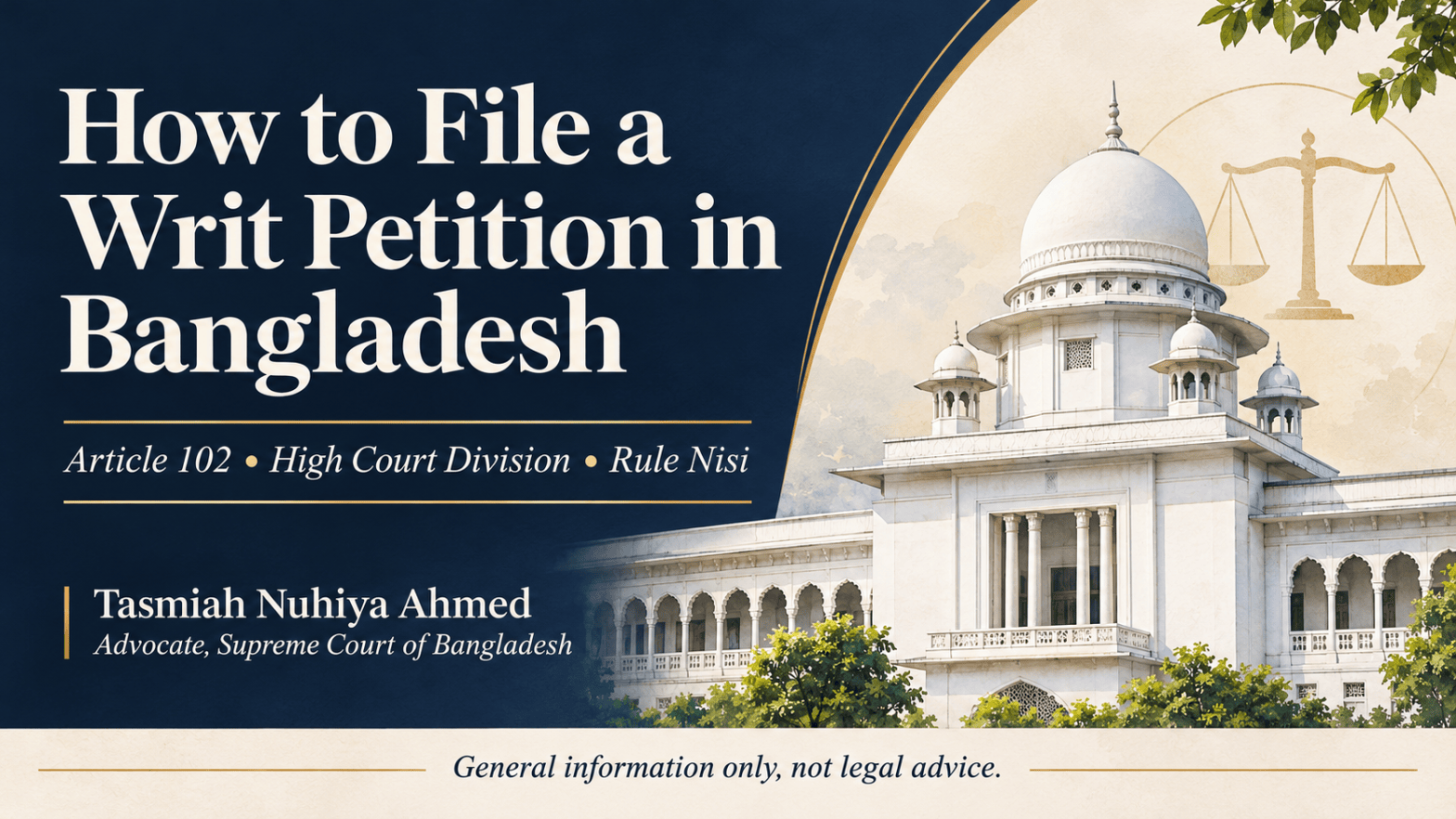
How to File a Writ Petition in the High Court Division

A writ petition is filed in the High Court Division of the Supreme Court of Bangladesh under Article 102 of the Constitution. It is used when a public authority acts unlawfully, or when a fundamental right is violated, and no other equally effective remedy is available.

What is a writ petition?

A writ petition asks the High Court Division to review the action or inaction of the government or a public body. It is a constitutional remedy, not an ordinary civil suit.

Who can file?

  • A person aggrieved by an action of a public authority or a person performing public functions.
  • Any person may apply in cases of habeas corpus (unlawful detention) and quo warranto (holding a public office without legal authority).
  • Public interest litigation may be brought by a person or organisation acting for a public cause.

Types of writs

  1. Habeas corpus: to produce a person who is allegedly detained unlawfully.
  2. Mandamus: to direct an authority to perform a legal duty.
  3. Prohibition: to stop a lower body from acting beyond its power.
  4. Certiorari: to quash an order made without lawful authority.
  5. Quo warranto: to challenge a person’s right to hold a public office.

Step by step

  1. Check the grounds. Identify the right violated or the law the authority broke.
  2. Check alternative remedies. If the law gives an efficacious remedy (an appeal or a tribunal), the Court usually expects it to be used first.
  3. Gather documents. The impugned order, relevant correspondence, and proof of your interest.
  4. Draft the petition and affidavit. State facts clearly, set out legal grounds, and name the respondents.
  5. File through an Advocate at the High Court Division and move the matter for hearing.
  6. Rule Nisi. If the Court finds a case worth hearing, it issues a Rule asking the respondents to show cause. The case is then heard in full.

Timing

There is no single fixed deadline, but unexplained delay can weaken a petition. Act promptly.

After the judgment

An aggrieved party may seek leave to appeal to the Appellate Division.

FAQ

Is a writ the same as an ordinary case? No. It is a constitutional remedy against public authorities.

Can I file against a private person? Generally not, unless the person performs public functions.

This article gives general information only and is not legal advice for any specific case.


#BangladeshLaw #WritPetition #ConstitutionalLaw
#how to file a writ petition in Bangladesh
Article 102, High Court Division, Rule Nisi


Seeking Answers on Two Bangladeshis Executed Abroad

By Tasmiah Nuhiya Ahmed, Advocate, Supreme Court of Bangladesh

What did the authorities know, when did they know it, and what diplomatic steps did they take?

These questions underpin my legal notice concerning two Bangladeshis executed in Saudi Arabia, as reported by Prothom Alo. The notice requests a written preliminary response within 24 hours of receipt.

Transparency allows families and the public to understand how institutions responded. Preserving records also makes meaningful scrutiny possible.

For Bangladesh, protecting citizens overseas must remain a continuing institutional priority. Every case should help identify where communication, assistance and coordination can improve.

Read Prothom Alo’s report: https://www.prothomalo.com/bangladesh/qole38sn4v

Protecting Dignity After the Milestone School Tragedy

By Tasmiah Nuhiya Ahmed, Advocate, Supreme Court of Bangladesh

A family grieving a child should not have to encounter images of that child’s suffering every time they open their phone.

On 3 August 2025, the High Court directed authorities to ensure that victims’ faces were blurred in photographs and videos of the Milestone School and College jet crash before publication across mainstream, digital and social media. The directive followed a public interest writ petition that I filed and argued.

The petition raised concerns about the distress caused to families by the continued circulation of graphic images of deceased and injured children.

For me, this matter carries a clear message: dignity must remain central to how we report and respond to tragedy.

Journalists have an essential role in documenting events, examining failures and pursuing accountability. Those responsibilities can be fulfilled while protecting victims from unnecessary exposure. Editors, content creators and individual social media users should consider the people behind every image before deciding to publish or share it.

Blurring faces is an important safeguard. Responsible judgment also means asking whether a graphic image needs to be published at all.

The children affected by the Milestone tragedy deserve to be remembered with care. Their families deserve space to grieve, and survivors deserve compassion as they rebuild their lives.

Before sharing distressing content, pause. Consider whose suffering it shows, who might encounter it, and whether sharing it serves a meaningful public purpose.

Read the report: The Daily Star — High Court directs blurring of Milestone victims’ images and videos

Tasmiah Nuhiya Ahmed
Advocate, Supreme Court of Bangladesh

General information and commentary; not legal advice.

Is this your new site? Log in to activate admin features and dismiss this message
Log In